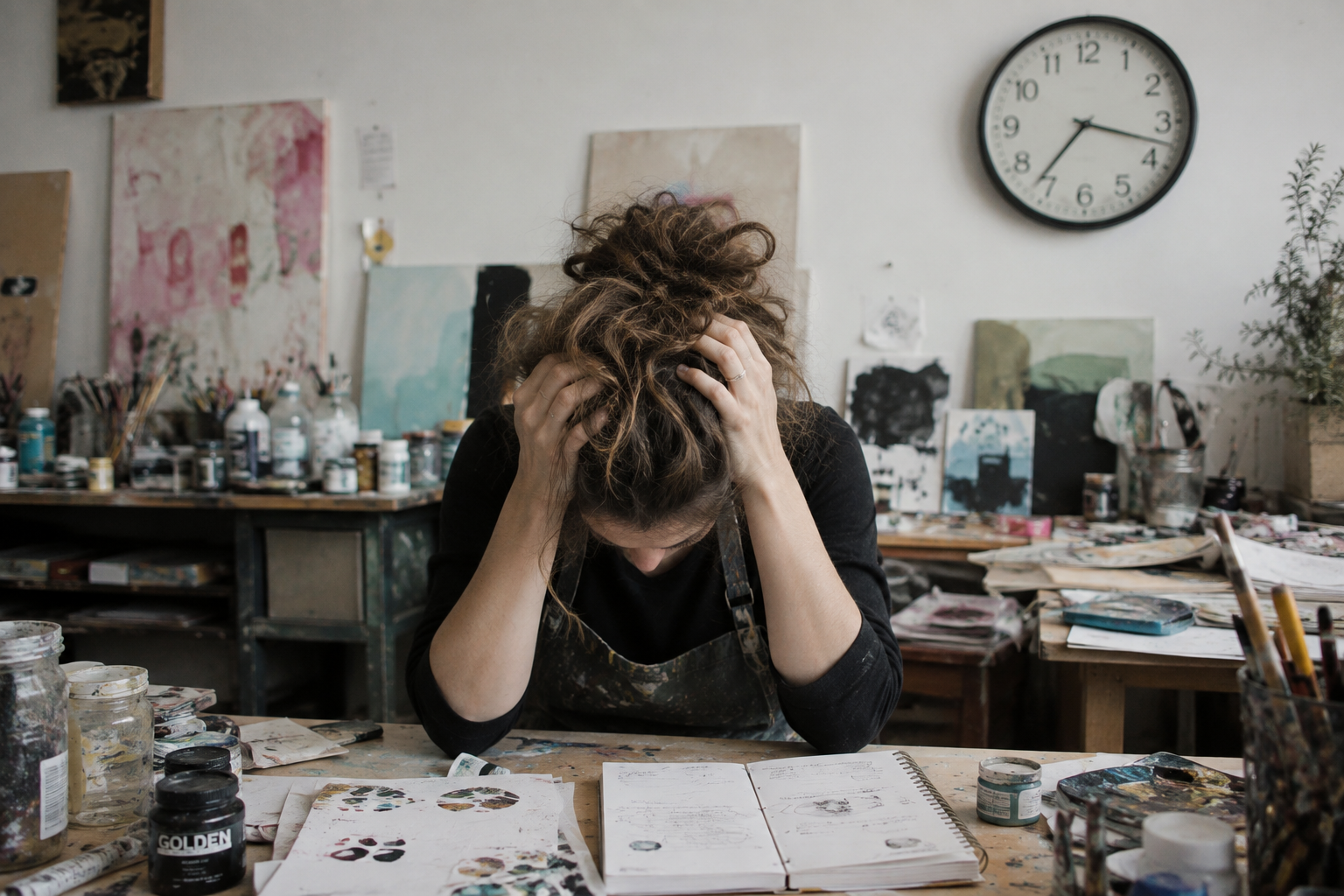
You have a deadline. You know exactly what needs to be done. You may even have everything you need to do it.
So naturally, you reorganize your art supplies.
You answer an email that could have waited until tomorrow.
You decide today is the perfect day to clean your studio.
You scroll Pinterest for “inspiration.”
You start a completely different creative project.
You make coffee.
Then more coffee.
And somehow, three hours later, you’ve been very busy without doing the one thing you actually needed to do.
Sound familiar?
If you’re an artist, designer, maker, writer, crafter, or simply someone with a creative brain, procrastination can become a particularly frustrating cycle. And here’s the important part:
Procrastination isn’t always about laziness or a lack of discipline.
A lot of the time, it’s about how your brain responds to a task that feels uncomfortable.
Your Brain Doesn’t Always Choose What Matters. It Chooses What Feels Better Right Now.
When we have something important to do—especially something difficult, uncertain, boring, overwhelming, or connected to our identity—our brains can experience a little emotional resistance.
- Maybe the project feels too big.
- Maybe you’re afraid it won’t turn out the way you imagined.
- Maybe you don’t know where to start.
- Maybe the deadline makes you anxious.
- Maybe you’re simply tired and the task requires more mental energy than you have available.
So your brain looks for an escape. And escape doesn’t necessarily mean lying on the couch doing nothing.
This is where creative people can get particularly good at procrastinating.
We don’t necessarily stop working.
We just work on the wrong thing. (Or at least this has been my observation…of myself 😭)
We might sketch something new instead of finishing the commission. We might redesign our website instead of listing the products we already made. We might research a new art technique instead of practicing the one we’re supposed to be learning. We might clean our workspace instead of creating. And because we’re technically being productive, it can be harder to recognize what is happening.
We’re productive procrastinating.
The Science Behind It
Research on procrastination increasingly points toward emotion regulation rather than simply poor time management.
When a task creates unpleasant feelings—boredom, anxiety, frustration, self-doubt, overwhelm—we may postpone the task because avoiding it provides immediate emotional relief. And that relief is powerful. Your brain essentially learns:
“I felt uncomfortable SO I avoided the task SO then I felt better.”
The problem is that the relief is temporary. (AND YOU KNOW IT WILL BE, UGH, SO WHY DO WE DO IT?)
Later, the deadline is closer, the task is still waiting, and now you’ve added another emotion:
stress.
That creates a nasty little loop:
Uncomfortable task → avoidance → temporary relief → guilt → increased stress → even more avoidance.
For creative people, there can be another layer. What? Absolutely unfair right?!
Creative work often doesn’t have a guaranteed outcome. You don’t always know whether the painting will work. You don’t know whether people will like the design. You don’t know whether the product will sell. You don’t know whether the book will succeed. You don’t even know whether you will like what you create.
That uncertainty can make starting feel much harder. (Ya think? 🤦♀️)
Why Creative Brains Can Be Especially Vulnerable
Creativity requires exploration. That’s one of its greatest strengths. Creative people naturally notice possibilities, make connections, chase ideas, experiment, and follow interesting little trails. That’s wonderful when you’re brainstorming.
It’s not always wonderful when you have a deadline.
Your brain says:
“Wait! What if we tried THIS instead?”
And suddenly you’re three hours into a new idea that wasn’t even on today’s schedule. This isn’t necessarily a bad thing. That curiosity is part of what makes you creative.
The trick is learning when to follow the idea and when to put it in the Creative Parking Lot (more on this later) and return to what you were supposed to be doing.
The Dangerous Part: The Creative Downward Spiral
Procrastination becomes particularly damaging when it starts affecting our relationship with creativity itself.
You put off the project.
The deadline gets closer.
You feel guilty.
You rush.
The finished work isn’t what you wanted.
You become frustrated with yourself.
Creating starts to feel stressful instead of enjoyable.
So you avoid creating again.
Eventually you may find yourself saying:
“I just don’t feel inspired anymore.”
But sometimes the problem isn’t that your inspiration disappeared.
You’re exhausted from constantly being behind.
It’s difficult to feel playful and imaginative when your brain is carrying around a growing list of unfinished things. And that is why learning to manage procrastination isn’t about becoming a productivity robot. It’s about protecting your creativity.
Five Ways to Stop Procrastination From Taking Over Your Creative Life
1. Separate “Creative Time” From “Deadline Time”
Not every creative activity serves the same purpose.
There is a difference between:
“I’m creating because I want to explore.”
and
“I’m creating because this needs to be finished by Friday.”
Treat them differently.
When you have a deadline, give yourself a defined block of deadline time. During that block, your job isn’t to explore every possibility. Your job is to move the project forward. Save your experimental ideas for your creative time. This gives your brain permission to explore later without allowing every shiny new idea to hijack today’s work.
Try this:
Before you begin, write:
TODAY’S JOB: __________
Then ask:
“What is the smallest thing I can finish that moves this project closer to done?”
Start there.
2. Make the First Step Almost Ridiculously Easy
A huge project creates huge resistance.
“Finish my website.”
“Paint the entire piece.”
“Finish my book.”
“Create my new product line.”
Your brain hears those sentences and thinks:
Absolutely not.
Instead, shrink the task.
Don’t:
“Finish the painting.”
Try:
“Set up my paints.”
Don’t:
“Finish the book.”
Try:
“Write the opening paragraph.”
Don’t:
“Launch my product.”
Try:
“Take one product photo.”
The goal isn’t to trick yourself. It’s to lower the psychological barrier to beginning. Once you’re moving, continuing often becomes easier.
3. Use a “Not Now” List for Your Brilliant Distractions
Creative people have ideas.
Lots of them.
And sometimes the ideas that interrupt your work are genuinely good ideas.
You don’t have to throw them away.
You just don’t have to act on them immediately.
Keep a notebook or document called:
THE NOT NOW LIST
When a new idea appears, write it down.
New Halloween shirt idea.
New journal concept.
What if I painted this differently?
I should redesign my business cards.
I need to learn how to make that technique.
Then go back to the task at hand.
This works because you’re not telling your brain:
“No.”
You’re telling it:
“Not now.”
There’s a huge psychological difference. Your ideas are safe. You are not going to lose them. You can come back to them.
But they don’t get to steal today’s deadline.
4. Notice What You’re Actually Avoiding
Sometimes procrastination isn’t about the task.
It’s about the feeling underneath the task.
Ask yourself:
“What am I trying not to feel right now?”
Are you avoiding:
- Fear that the work won’t be good enough?
- Boredom?
- Confusion?
- Overwhelm?
- Perfectionism?
- Fear of judgment?
- The possibility that your idea won’t work?
- The pressure of a deadline?
Once you identify the emotion, you can address the actual problem.
If you’re overwhelmed, break the project down.
If you’re afraid it won’t be good enough, give yourself permission to make a terrible first draft.
If you’re confused, identify the one question you need answered.
If you’re bored, set a timer and promise yourself you only have to work for 15 minutes.
You don’t always need more motivation.
Sometimes you need to make the uncomfortable part smaller.
5. Stop Waiting to “Feel Creative”
This one may be the hardest.
We often assume creativity should feel like inspiration. But professional creative work can’t always wait for inspiration to arrive. Sometimes you create because you’re inspired.
Other times, creating is what brings the inspiration back.
Think of creativity more like a muscle than a magical feeling.
You don’t have to feel motivated to begin.
You can begin while feeling tired.
You can begin while feeling uninspired.
You can begin badly.
You can begin for fifteen minutes.
And sometimes, somewhere in the middle of those fifteen minutes, your brain finally catches up and says:
“Oh. We’re doing this. I have an idea.”
The Goal Isn’t to Never Procrastinate
Let’s be honest.
You’re probably going to procrastinate again.
So am I.
We’re human.
And sometimes rearranging the studio really is the thing that needs to happen.
The goal isn’t to eliminate procrastination completely. The goal is to notice when you’re using other activities as an escape from something important. Because there is a big difference between:
“I need a creative break.”
and
“I’m avoiding something that makes me uncomfortable.”
One restores you. The other quietly digs the hole a little deeper.
And if you’ve already fallen into that hole?
Don’t make the mistake of thinking you have to climb all the way out today. Pick one thing. One email. One sketch. One product photo. One paragraph. One brushstroke. One tiny step. Then another.
Because the way out of a creative slump usually isn’t one giant burst of inspiration.
It’s movement.
And sometimes the most creative thing you can do is simply begin.
A Little Creative Twenty8 Reminder
- You don’t have to be perfectly productive to be creative.
- You don’t have to finish everything today.
- You don’t have to turn every idea into something.
- And you definitely don’t have to earn your creativity by being productive.
But when procrastination starts stealing your deadlines, your confidence, and eventually your desire to create, it’s worth paying attention.
Protect your creative mind.
Give it room to wander.
Give it permission to play.
But every once in a while, gently take it by the hand and say:
“That’s a great idea. We’ll come back to it. Right now, let’s finish this one.”
Leave a Reply