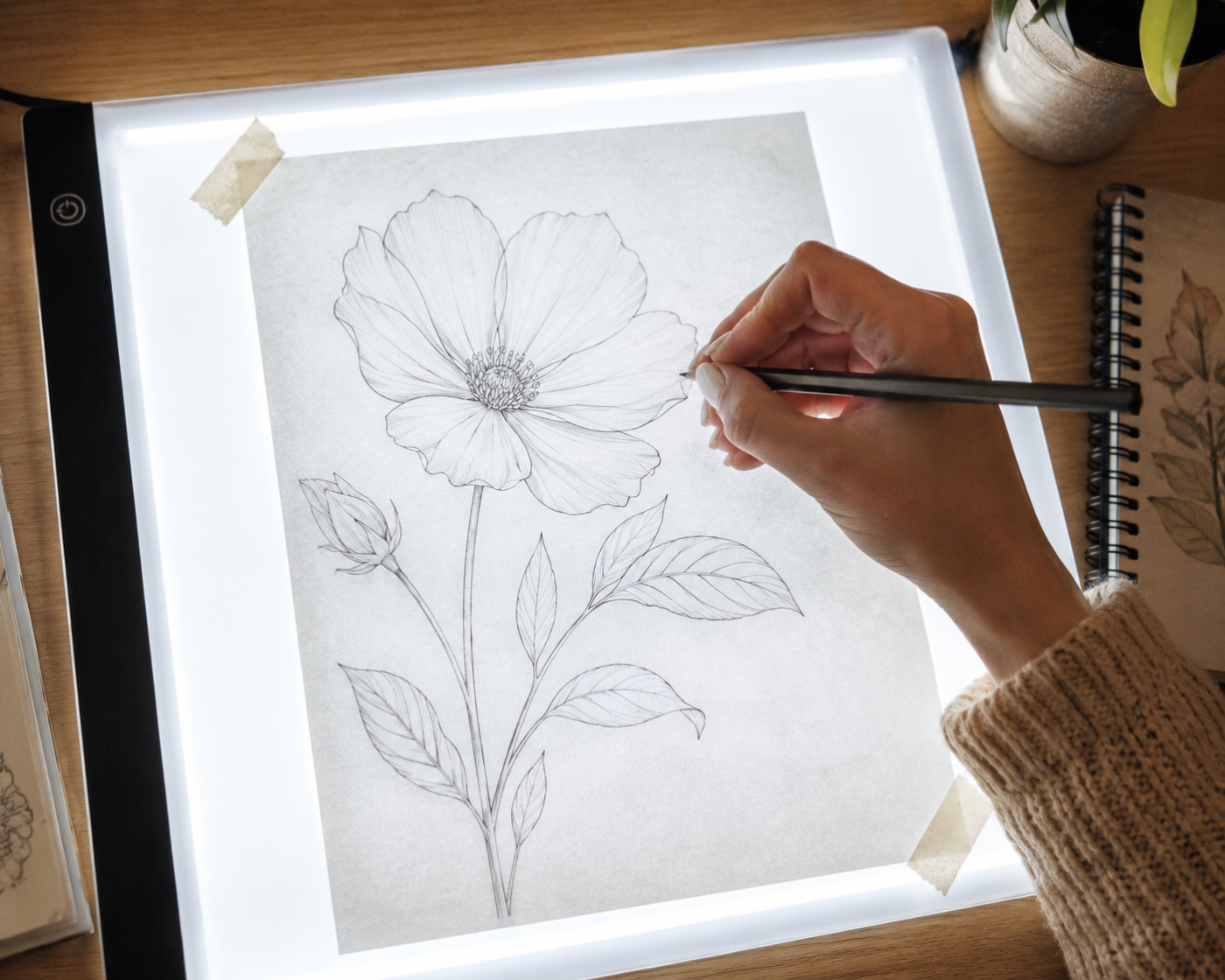
Few topics in the art world spark debate as quickly as tracing.
Some artists see it as “cheating.” Others quietly use it as part of their learning process. But when tracing is used intentionally — not as a shortcut, but as a study method — it can help develop real artistic skills.
In fact, research on motor learning, visual processing, and visuomotor coordination suggests that tracing can strengthen the connection between what artists see, what they understand, and what their hands learn to reproduce.
Tracing will not replace foundational practice, creativity, or observational drawing. But it can be a powerful training tool.
Tracing Helps Build Motor Memory
When artists repeatedly trace shapes, contours, and forms, they are training more than their hands.
They are strengthening neural pathways involved in fine motor control and hand-eye coordination.
Scientists refer to this type of learning as procedural memory or motor learning — the same system involved in learning handwriting, playing an instrument, or mastering athletic movement patterns.
Research published in Scientific Reports found that repeated tracing exercises improved movement steadiness and visuomotor accuracy, particularly when participants received continuous visual feedback while tracing.
In simpler terms:
the brain gradually learns how certain lines, curves, and motions feel to create.
Over time, this repetition can help artists develop:
- smoother line control
- steadier hand movements
- improved stroke confidence
- better coordination between vision and motion
This is one reason many artists notice that studying poses, anatomy, or perspective through tracing can later improve their freehand drawing ability.
Tracing Strengthens Visual Memory
Drawing is not only a physical skill — it is also a cognitive one.
When tracing mindfully, the brain actively processes:
- proportions
- angles
- spacing
- edge relationships
- shape construction
- directional flow
Instead of passively looking at an image, the artist is engaging multiple systems simultaneously:
visual analysis, spatial reasoning, and physical movement.
Studies on visuomotor learning show that combining visual observation with physical action strengthens memory formation and improves coordination between perception and movement.
This matters because strong artists do not simply memorize pictures —
they build an internal understanding of structure.
Over time, repeated exposure to forms through tracing can help artists better recognize and recall:
- facial proportions
- anatomy rhythms
- perspective relationships
- gesture flow
- shape simplification
That visual familiarity often carries over into original work later.
Tracing Trains Observation Skills
One of the most overlooked benefits of tracing is that it slows artists down.
Beginners often think they are observing carefully, but the brain naturally simplifies complex visual information. Tracing forces the eye to follow subtle changes in shape, spacing, and movement that might otherwise go unnoticed.
For example, tracing can help artists notice:
- how lips seamlessly connect to the philtrum
- how folds wrap around form
- how curves transition into straight edges
- how weight and balance affect gesture
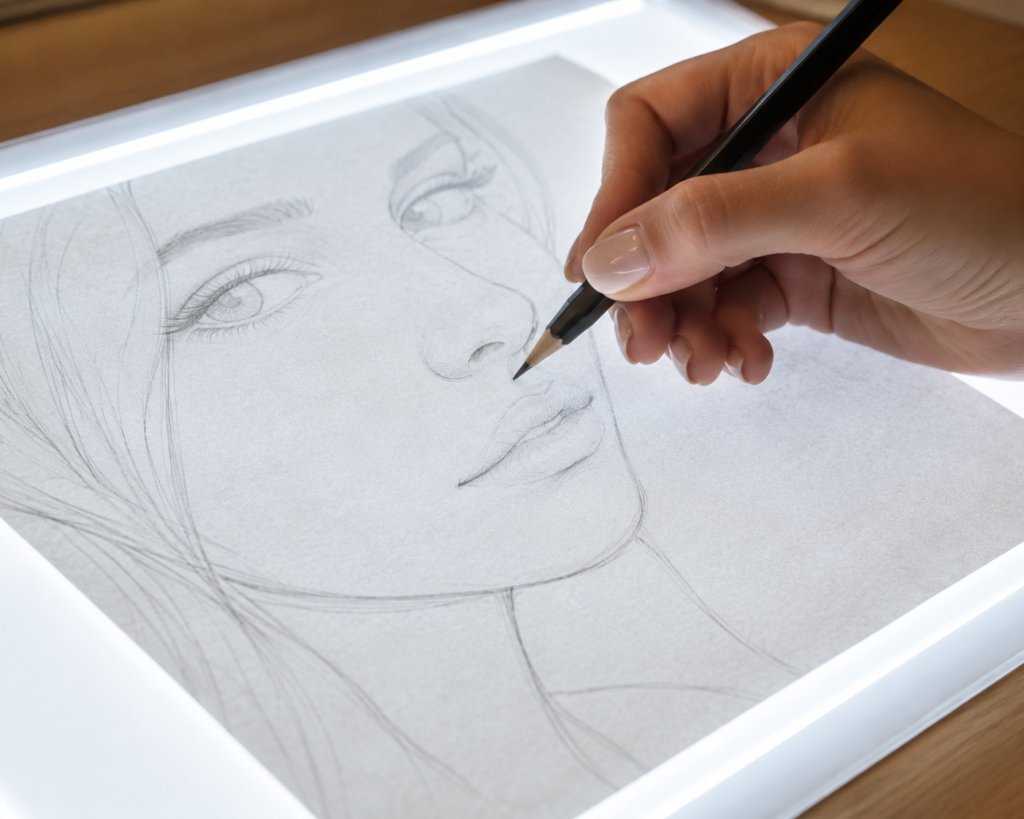
In neuroscience and motor-learning research, this connection between visual input and physical movement is known as visuomotor coordination — the process of translating what we see into controlled action.
Artists strengthen this coordination every time they intentionally study and reproduce visual information.
The Difference Between Helpful Tracing and Passive Copying
Tracing only becomes valuable when it is done consciously.
Passive tracing is simply following lines without thinking.
Mindful tracing asks questions:
- Why is this curve shaped this way?
- Where is the weight distributed?
- What basic forms build this structure?
- How does this line describe movement?
The purpose is not dependency.
The purpose is training observation, control, and understanding.
Used this way, tracing becomes similar to how musicians practice scales or athletes repeat drills: not as the final performance, but as structured skill development.
Professional Artists Have Always Used Study Methods Like This
Many professional artists use forms of tracing during planning, studying, drafting, or animation workflows.
Traditional animation relied heavily on tracing and repeated frame construction to train consistency and understand motion. Designers, illustrators, painters, and tattoo artists often use tracing techniques to study composition, anatomy, or structure.
The important distinction is whether the artist is:
- learning from the process
-or- - simply presenting traced work as fully original
Those are not the same thing.
Final Thoughts
Tracing is not a magic shortcut.
It will not replace creativity, imagination, construction practice, or observational drawing from life.
But when used intentionally, tracing can help artists:
- improve hand-eye coordination
- strengthen motor memory
- build visual familiarity with forms
- develop line confidence
- improve observational awareness
- better understand structure and movement
Tracing is not the destination.
It is one of many tools artists can use to train the brain, the eye, and the hand to work together more effectively.
So give it a try. Trace until you can trace no more and then tell me your results. Did tracing help you become a better artist? Leave your results, thoughts, or comments below. I love to know what you think!
Leave a Reply